Skip to Content
  • Resources & Support
    • Terms of Use
    • Privacy Policy
  • About
  • Contact
  • For Patients
Search Search
  • Prosthetic Urology
    • Therapy
      • Erectile Restoration
      • Male Continence
      • Testicular Replacement
    • Products
    • Clinical Evidence
    • Clinical Education
    • Resources
      • Guided Support | Men’s Health
      • Men’s Health
        media kit
      • MOTIVATED Podcast
      • Reimbursement & Benefit Support
      • Resources for Referring Physicians
  • Endourology
    • Therapy
      • Stone Management
      • Prostate Health
    • Products
    • Clinical Evidence
    • Clinical Education
    • Resources
  • Female Pelvic Medicine
    • Therapy
      • Pelvic Floor Reconstruction
      • Female Continence
    • Products
    • Clinical Evidence
      • Altis® Single Incision Sling System Clinical Compendium
      • Restorelle® Ultra Lightweight Mesh Clinical Compendium
    • Clinical Education
    • Resources
      • Guided Support | Women’s Health
      • Reimbursement
      • Women’s Health media kit
  • Erectile restoration

    • Penile prosthesis

      • Titan® Penile Implants
      • Genesis® Malleable Penile Prosthesis
    • Pericardium allografts

      • Tutoplast® Pericardium Allograft
    • Surgical instruments and accessories

      • Titan® Assembly Kit
      • Furlow Insertion Tool
  • Male continence

    • Male continence products

      • Virtue® Male Sling System
  • Testicular replacement

    • Testicular replacement products

      • Torosa® Saline-Filled Testicular Prosthesis
  • Access

    • -

      • Soprano® Hybrid Guidewire
      • Orchestra® Hydrophilic Nitinol Guidewires
      • PTFE-Coated Seldinger Guidewires
      • Ureteric Catheters
      • Ureteral Dilators
      • ReTrace® Access Sheath
  • Visualization

    • -

      • Urofino Single-Use Flexible Ureteroscope
  • Treat

    • -

      • Coloplast TFL Drive
        Thulium Fiber Laser & Fibers
      • SabreGuard® and SabreLine® Holmium Laser Fibers
  • Collection

    • -

      • Dormia® Nitinol Stone Baskets
      • Dormia® DualPerc PCNL Basket
  • Stent

    • -

      • ImaJin® Hydrophilic-Coated Silicone Ureteral Stent
      • Biosoft® Duo Double Loop Ureteral Stents
      • Vortek® & Vortek® Hydro Ureteral Stents
      • Stenostent® Ureteral Stents
      • NovoFlow™ Reinforced Ureteral Stent
      • Pyelostent® Ureteral Stent
  • Drainage

    • -

      • X-Flow® Silicone Prostatic Catheters
      • Folysil® Silicone Catheters
Dormia Product Family Mobile Header

Dormia Product Family

Dormia® Nitinol Stone Baskets

  • Pelvic floor reconstruction

    • Products

      • Saffron™ Fixation System
      • Axis™ Dermis & Suspend® Fascia Lata Tutoplast® Processed Allografts
      • Restorelle® Y Mesh
  • Female continence

    • Mid-urethral slings

      • Altis® Single Incision Sling
      • Aris® Transobturator Sling System
      • Supris® Retropubic Sling System
    • Injectables

      • BoNee® Needle

Altis® Single Incision Sling

  • Prosthetic Urology
    • Therapy
      • Erectile Restoration
      • Male Continence
      • Testicular Replacement
    • Products
    • Clinical Evidence
    • Clinical Education
    • Resources
      • Guided Support
      • Men’s Health media kit
      • MOTIVATED Podcast
      • Reimbursement & Benefit Support
      • Resources for Referring Physicians
  • Endourology
    • Therapy
      • Stone Management
      • Prostate Health
    • Products
    • Clinical Evidence
    • Clinical Education
    • Resources
  • Female Pelvic Medicine
    • Therapy
      • Pelvic Floor Reconstruction
      • Female Continence
    • Products
    • Clinical Evidence
      • Altis® Single Incision Sling System Clinical Compendium
      • Restorelle® Ultra Lightweight Mesh Clinical Compendium
    • Clinical Education
    • Resources
      • Reimbursement
      • Women’s Health media kit
  • Resources & Support
    • Terms of Use
    • Privacy Policy
  • About
  • Contact
  • For Patients
  • Search

Restorelle® Ultra Lightweight Mesh
Clinical Compendium

Designed by a Urogynecologist for the female pelvic floor

#1 Y-Mesh on the market

More than 2,000 women treated in Restorelle clinical trials

Ultra lightweight + high long-term success rates

Celebrating 15 years of Restorelle


Quick Links: Featured studies | Published studies | Ordering info | Important safety information


Restorelle redefined surgical outcomes and continues to restore patient anatomy and renew quality of life.

Restorelle Y incorporates Smartmesh technology in customized shapes specifically for sacrocolpopexy procedures.

It is the first mesh designed by a surgeon, specifically with a woman’s anatomy and tissue healing requirements in mind.

Extensively studied. Consistent results.

This compendium summarizes the clinical evidence for efficacy and safety of Restorelle Ultra Lightweight Mesh, which is indicated for use as a bridging material for sacrocolposuspension/sacrocolpopexy (transabdominal placement via laparotomy, laparoscopic, or robotic approach) where surgical treatment for vaginal vault prolapse is warranted.

Learn more about Restorelle

Featured Studies

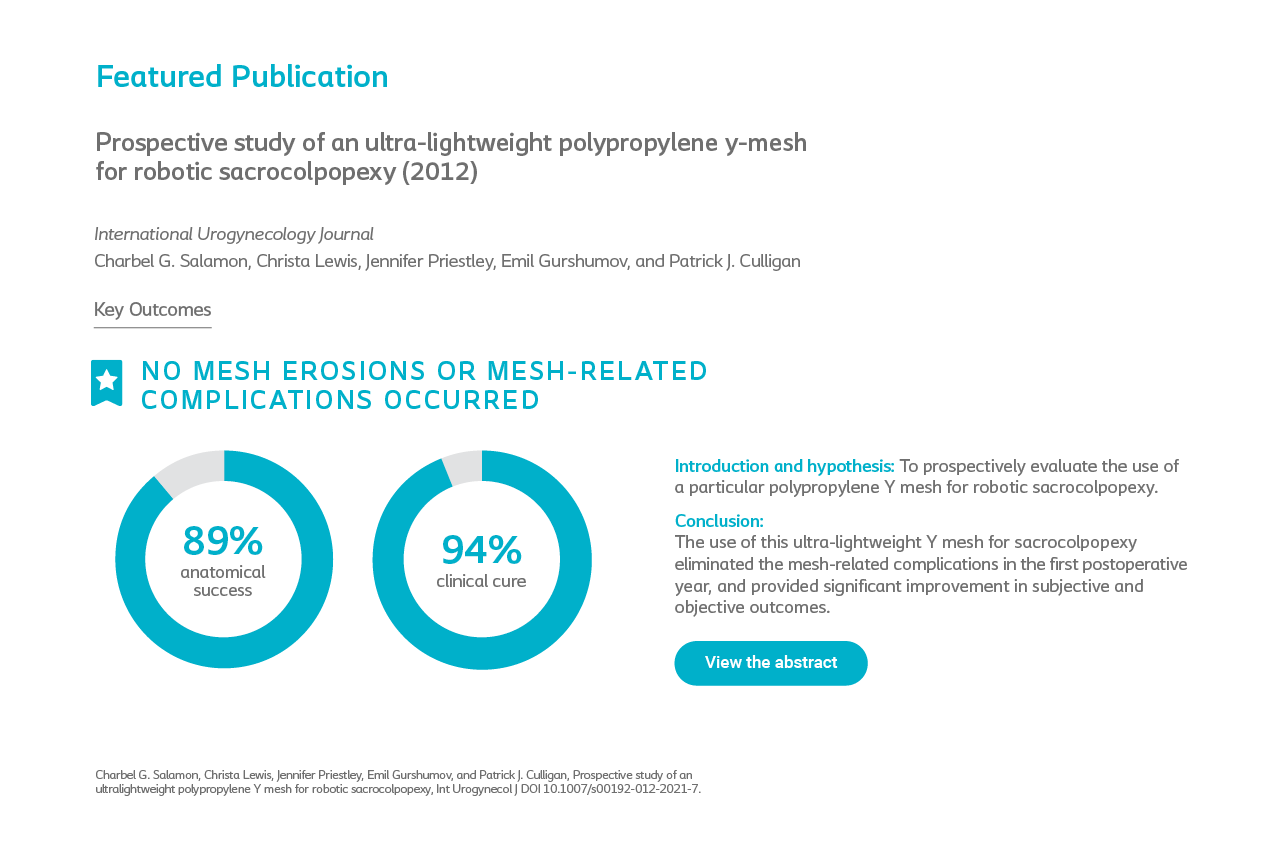
iuj_salamon-lewis-priestley-gurshumov-culligan

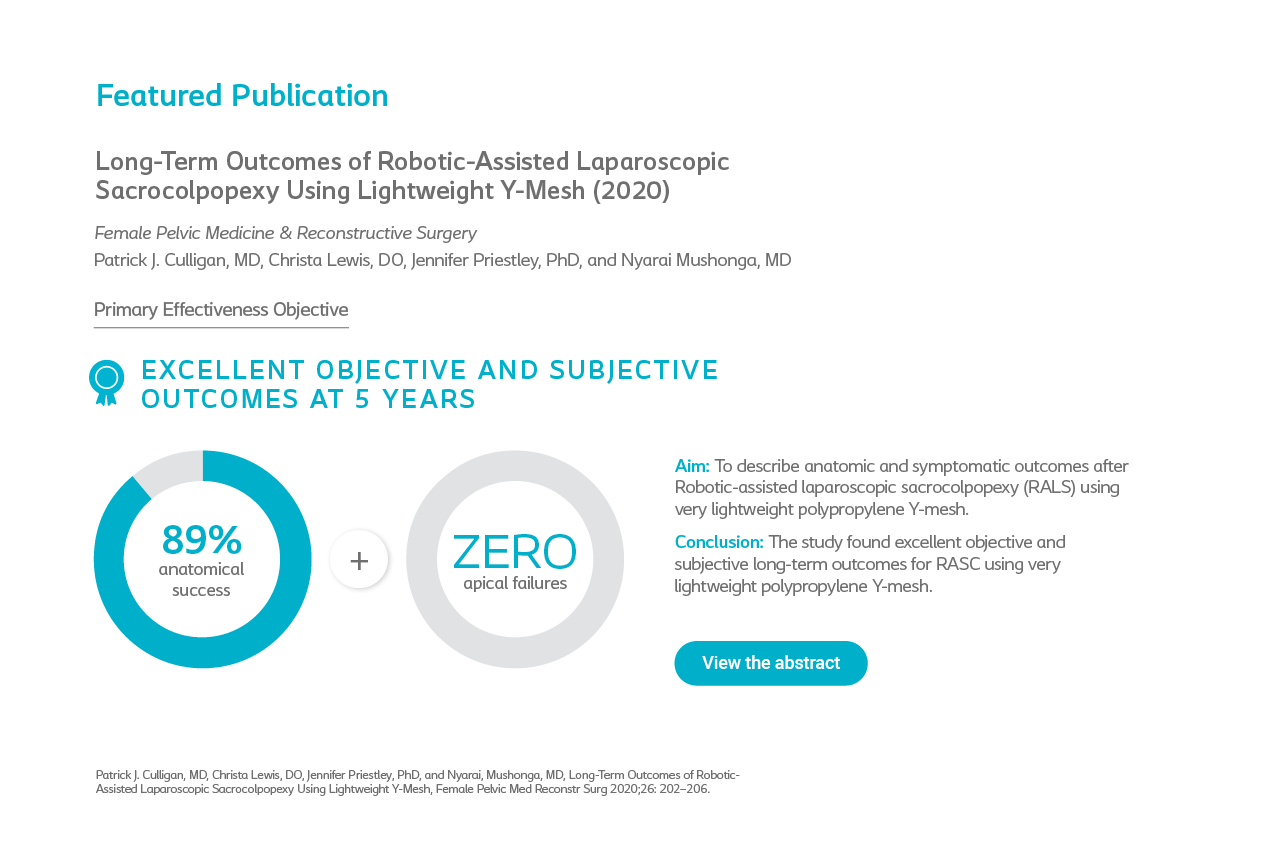
fpm&rs_ culligan-lewis-priestly-mushonga

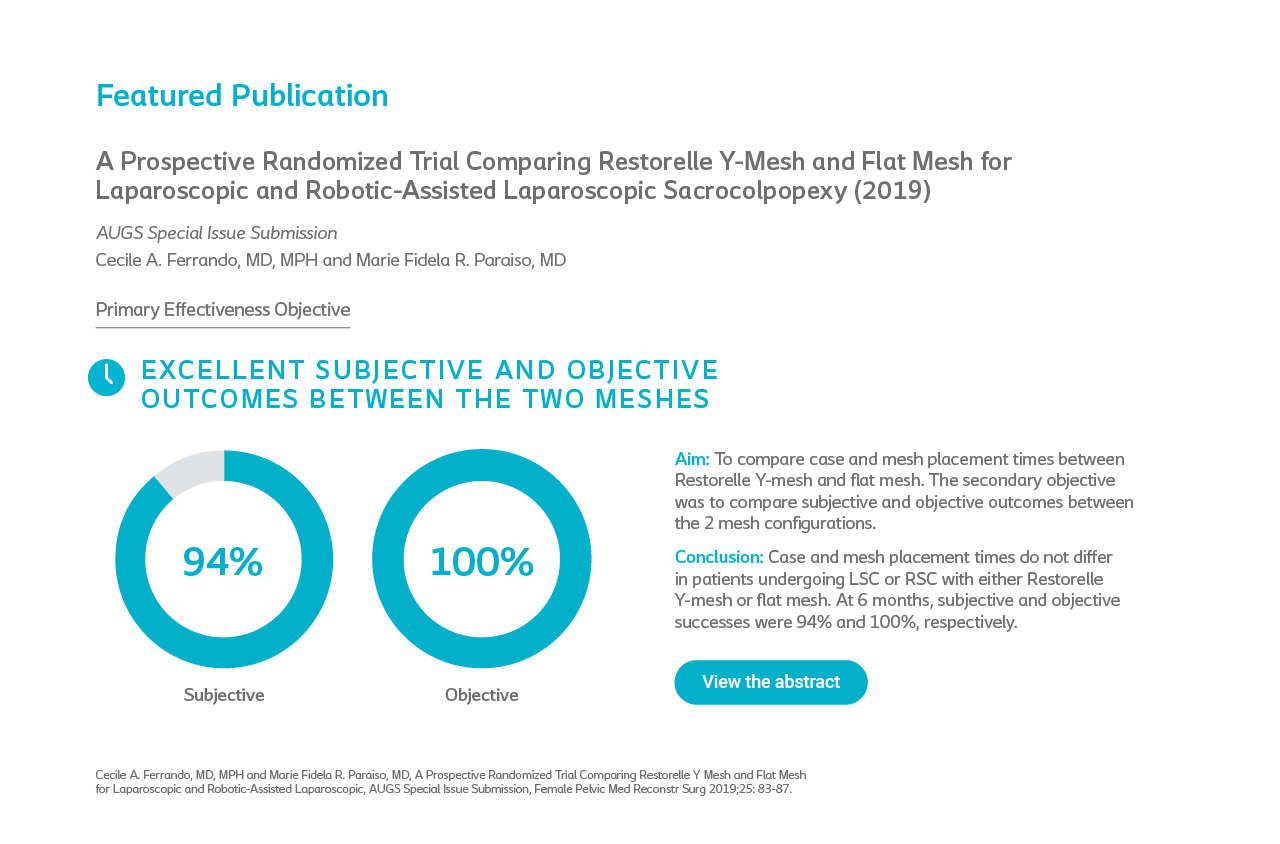
augs_ferrando-paraiso

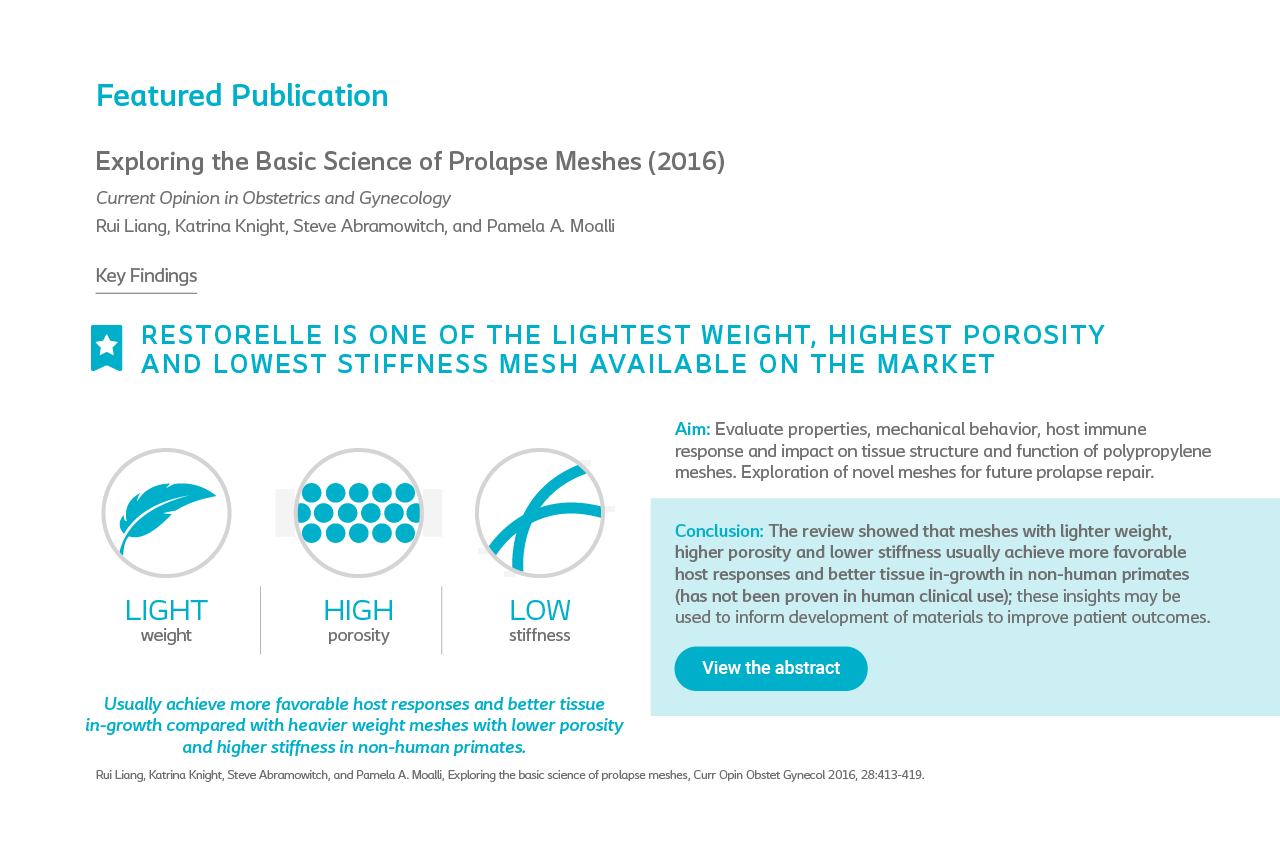
coog_liang-knight-abramowitch-moall

Published Clinical Studies

Lead Author Title Publication Year Coloplast Sponsored?
Giugale Assessing pelvic organ prolapse recurrence
after minimally invasive sacrocolpopexy:
does mesh weight matter?
International Urogynecology Journal 2021 No
Ferrando A prospective randomized trial comparing
Restorelle Y mesh and flat mesh for laparoscopic
and robotic-assisted laparoscopic sacrocolpopexy:
24-month outcomes
International Urogynecology Journal 2021 Yes
Culligan Long-Term Outcomes of Robotic-Assisted
Laparoscopic Sacrocolpopexy Using
Lightweight Y-Mesh
Female Pelvic Medicine & Reconstructive Surgery 2020 No
Askew Does Mesh Weight Affect Time to Failure After
Robotic-Assisted Laparoscopic Sacrocolpopexy?
Female Pelvic Medicine & Resconstructive Surgery 2020 No
Ferrando A prospective randomized trial comparing
Restorelle Y mesh and flat mesh for laparoscopic
and robotic-assisted laparoscopic sacrocolpopexy
AUGS Special Issue Submission 2019 Yes
Dwyer Laparoscopic sacrocolpopexy (LSCP) using an
ultra-lightweight polypropylene mesh
European Journal of Obstetrics & Gynecology and Reproductive Biology 2019 Yes
Mahoney Laparoscopic sacrocolpopexy posthysterectomy:
intraoperative feasibility and safety in obese women
compared with women of normal weight
International Urogynecology Journal 2019 Yes
Durst Polypropylene Mesh Predicts Mesh/Suture
Exposure After Sacrocolpopexy Independent of
Known Risk Factors: A Retrospective
Case-Control Study
Female Pelvic Medicine & Resconstructive Surgery 2017 No
Pandeva Efficacy and Pregnancy Outcomes of Laparoscopic
Single Sheet Mesh Sacrohysteropexy
Neurourology and Urodynamics 2017 No
Shatkin-Margolis Titanium Surgical Tacks: Are They Safe?
Do They Work?
Female Pelvic Medicine & Reconstructive Surgery 2017 No
Gupta Analysis of changes in sexual function in women
undergoing pelvic organ prolapse repair with
abdominal or vaginal approaches
International Urogynecology Journal 2016 No
Mueller Outcomes in 450 Women After Minimally
Invasive Abdominal Sacrocolpopexy for Pelvic
Organ Prolapse
Female Pelvic Medicine & Reconstructive Surgery 2016 No
Liang Exploring the basic science of prolapse meshes Current Opinion in Obstetrics and Gynecology 2016 No
Nosti Transvaginal Versus Transabdominal Placement of
Synthetic Mesh at Time of Sacrocolpopexy
Female Pelvic Medicine & Reconstructive Surgery 2015 No
Tan-Kim A randomized trial of vaginal mesh attachment
techniques for minimally invasive sacrocolpopexy
International Urogynecology Journal 2015 No
Fayyad Safety and One Year Outcomes Following Vaginally
Assisted Laparoscopic Uterine Sacropexy (VALUES)
for Advanced Uterine Prolapse
Neurourology and Urodynamics 2013 No
Salamon Prospective study of an ultra-lightweight
polypropylene Y mesh for robotic sacrocolpopexy
International Urogynecology Journal 2013 Yes
Antosh Short-Term Outcomes of Robotic Versus
Conventional Laparoscopic Sacral Colpopexy
Female Pelvic Medicine & Reconstructive Surgery 2012 No
Salamon Optimizing Efficiency With Robot-Assisted
Laparoscopic Sacrocolpopexy
The Female Patient 2010 No

Ordering information

For ordering information, please call 800-258-3476.

Request additional information

  • This field is for validation purposes and should be left unchanged.
  • By submitting the information on this form, you acknowledge that you agree to be contacted and accept the Coloplast Declaration of Consent and Privacy Policy.

Follow us

Keep up with the latest information on products, education/training and events.

x-social linkedin-social bluesky-social

PM-25850


Restorelle M, L and XL, Restorelle Y, and Restorelle Y Contour Polypropylene Mesh Brief Statement

Indications
Restorelle M, L and XL, Restorelle Y, and Restorelle Y Contour are indicated for use as a bridging material for sacrocolposuspension/sacrocolpopexy (transabdominal placement via laparotomy, laparoscopic, or robotic approach) where surgical treatment for vaginal vault prolapse is warranted.

Contraindications
It is the responsibility of the physician to advise the prospective patients or their representatives, prior to surgery, of the contraindications associated with the use of this product. The Restorelle M, L and XL, Restorelle Y, and Restorelle Y Contour are contraindicated for use in patients with the following conditions:

  • Pregnancy or desire for future pregnancy
  • Potential for further growth (e.g., adolescents)
  • Pre-existing local or systemic infection. Treat the infection with the appropriate antiseptics and/or antibiotics to eliminate the infection before placing the Restorelle M, L, or XL, Restorelle Y, or Restorelle Y Contour mesh
  • Taking anti-coagulant therapy
  • Any condition, including known or suspected pelvic pathology, which could compromise implant or implant placement
  • Sensitivity/allergy to polypropylene

Warnings & Precautions
It is the responsibility of the physician to advise the prospective patients or their representatives, prior to surgery, of the warnings and precautions associated with the use of this product and the associated surgical risks.

The effectiveness of Restorelle Y Contour has not been validated by a prospective, randomized clinical trial.

Warnings
Restorelle M, L and XL, Restorelle Y, and Restorelle Y Contour mesh should only be used by physicians familiar with the surgical procedures and techniques involving non-absorbable mesh and who have adequate education and experience in the treatment of pelvic organ prolapse.

A thorough assessment of each patient should be made to determine the suitability of a synthetic mesh procedure.

The patient should be counseled that alternative prolapse treatments may be appropriate, and the reason for choosing a surgical mesh procedure should be explained.

Obtain patient consent prior to surgery and ensure that the patient has an understanding of the postoperative risks and potential complications of transabdominal mesh surgery.

Patient counseling should include a discussion that the mesh to be implanted is a permanent implant and that some complications associated with the implanted mesh may require additional surgery; repeat surgery may not resolve these complications. Serious adverse tissue responses or infection may require removal of mesh, and complete removal of the mesh may not always be possible. Individuals may have varying degrees of collagen laydown that may result in scarring.

Patient Warnings
As with all surgical procedures, patients with certain underlying conditions may be more susceptible to postoperative bleeding, impaired blood supply, compromised/delayed healing, or other complications and adverse events.

The risks and benefits of using Restorelle M, L and XL, Restorelle Y, and Restorelle Y Contour should be considered in patients with: • Age-related underlying conditions • Autoimmune disease

• Coagulation disorder • Connective tissue disorder • Debilitated or immunocompromised state • Diabetes • Pelvic radiation therapy or chemotherapy • Physical characteristics (e.g., body mass index) • Smoking-related underlying conditions • Urinary tract anomalies.

Any future pregnancy could negate the benefits of this surgical procedure. Patients should report any bleeding, pain, abnormal vaginal discharge or sign of infection that occur at any time.

Procedure Warnings
Avoid placing excessive tension on the Restorelle M, L and XL, Restorelle Y, and Restorelle Y Contour mesh implant during placement and adjustment to maintain mesh integrity.

There should be an appropriate margin of mesh extending beyond the fixation points.

Inadequate fixation of the mesh material to the pelvic tissue may lead to failure of the repair and recurrence of the prolapse.

Procedure Precautions
Use caution to avoid neurovascular injury. Observe patient for any signs of abnormal bleeding or clinical signs of nerve damage.

Potential Complications
Adverse events are known to occur with transabdominal synthetic mesh procedures and implants. Adverse events following mesh implantation may be de novo, persistent, worsening, transient, or permanent.

Adverse events may include but are not limited to: • Abscess (acute or delayed) • Adhesion/scar formation • Allergy, hypersensitivity or other immune reaction • Bleeding, hemorrhage or hematoma • Bowel Related (Bowel obstruction, Constipation and/or defecatory dysfunction, Fecal incontinence and/or anal sphincter incompetence, Ileus) • Dehiscence • Delayed wound healing • Extrusion, erosion or exposure of mesh into the vagina or other structures or organs • Fistula formation • Infection • Inflammation (acute or chronic) • Local irritation • Mesh migration • Necrosis • Pain Related (De novo and/or worsening dyspareunia, Neuromuscular symptoms (acute or chronic), Pain (acute or chronic), Partner pain and/or discomfort during intercourse) • Perforation or injury of soft tissue (e.g., ligaments, muscles, nerves, vessels), structures, or organs (e.g., bowel, rectum, bladder, urethra, ureters, vagina) • Seroma • Suture erosion • Urinary Related (Bladder storage dysfunction (e.g., increased daytime frequency, urgency, nocturia, overactive bladder, urinary incontinence), Ureteral obstruction, Urinary tract infection, Voiding symptoms (e.g., dysuria, urinary retention, incomplete emptying, straining, positional voiding, weak stream) • Vaginal Related (De novo or worsening prolapse in untreated compartment, Granulation tissue formation, Palpable mesh (patient and/or partner), Recurrent prolapse, Sexual dysfunction, Vaginal discharge (abnormal), Vaginal scarring, tightening, rigidity, shortening and/or contracture.

The occurrence of adverse events may require one or more revision surgeries, including removal of the mesh. Complete removal of the mesh may not always be possible, and additional surgeries may not always fully correct the complications. There may be unresolved pain with or without mesh explantation.

The information provided is not comprehensive with regard to product risks. For a comprehensive listing of indications, contraindications, warnings, precautions, and adverse events refer to the product’s Instructions for Use. Alternatively, you may contact a Coloplast representative at 1-800-258-3476 and/or visit the company website at www.coloplast.com.

Caution: Federal law (USA) restricts this device to sale by or on the order of a physician.

PM-30439 02/24

Coloplast Corp
1601 West River Road North
Minneapolis MN 55411 USA
1-800-258-3476

© 2026 Coloplast Corp

Limit the use of my sensitive information
Do not sell or share my personal information
Manage Cookie Settings

  • Cookies
  • Privacy
  • Terms
  • Consent